
THE BOTTOM LINE
Skeletal Muscle Mass — and the way we interpret it through Skeletal Muscle Index, strength and function — tells you far more about your midlife health than body fat percentage, weight, or BMI ever will.
What really matters is:
- How much muscle you have
- How strong it is
- How well it works in real life
You don’t need perfect numbers.
You need enough strong, useful muscle doing its job.
That’s your baseline, and the part you get to build, maintain, or top up as you go.
THE HOW-TO
Step 1: Use whatever tools you have to assess your baseline
- SMI from a DEXA or BIA scale
- Loaded Carry at home
- Hand Grip Strength if you have access to a dynamometer
- Sit-to-Stand and Gait Speed tests
Step 2: Ask the three baseline questions
❓ Do I have enough muscle?
❓ Is it strong?
❓ Can I use it well?
Step 3: Interpret the answers
a) If you have none, do you want some? – It’s never too late to get some. Ever.😉
b) If you have some, do you need some more? – A small top-up can dramatically improve resilience.
c) If you have enough, can you simply idle on by? – Maintain and enjoy it, but beware of complacency.
d) If you have enough, are you tempted to push for too much? – Because yes, overdoing it can backfire on your recovery and hormones.
If you answered “Yes” to a) or b), identify what’s missing:
Mass? Strength? Function?
Once you know your direction, you can take action.
Step 4: Choose your next step
• Need clarity? → The 5 Day Midlife Fitness Audit
• Ready to build strength?→Made to Move
• Want personalised guidance?→ Discovery Call
• In pain or limited?→ The Practice Room
• Prefer to start gently? →Small, consistent strength sessions at home
Remember:
The real goal isn’t a number — it’s a feeling.
It’s moving through life with ease, recovering well, carrying your suitcase, lifting your groceries, and being resilient to whatever midlife throws at you.
THE SCIENCEY-STUFF
Starting from the beginning…
So, we’ve chewed the cud quite extensively about body fat — what it is, why it matters, and where it likes to hide (refresher courses available at The Menopause Gold Rush and Inside Job – Beyond the Percentage 😉). Which raises the next logical question:
Why all the fuss about Skeletal Muscle Mass (SMM)?
Quick detour:
“Lean mass” = everything that isn’t fat (muscle, organs, water, connective tissue).
“Skeletal muscle mass” = the stuff attached to your bones that lets you move.
We’re talking about that.
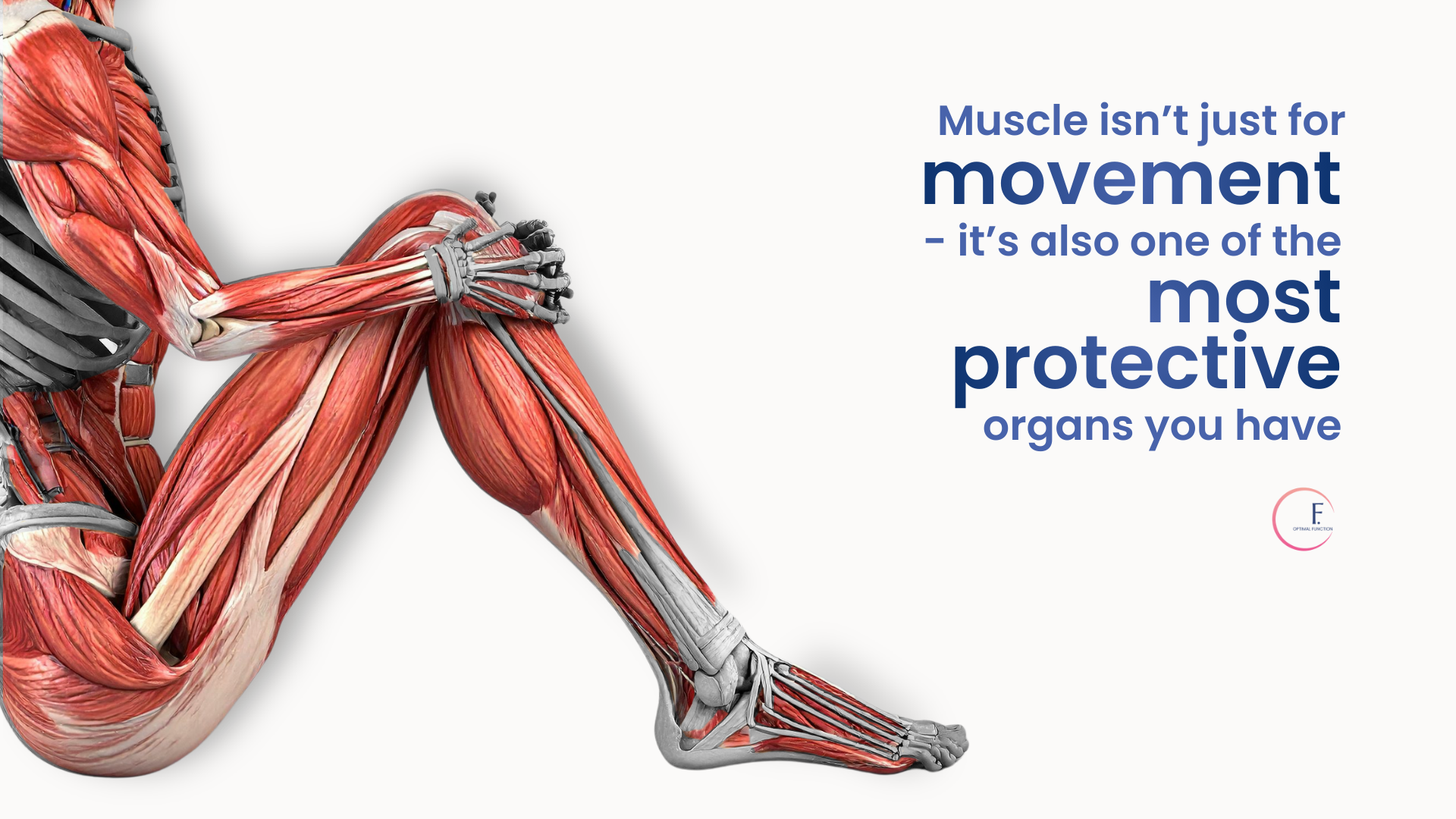
Muscles aren’t just for getting moving or lifting weights. They’re one of the most protective organs you have. They’re metabolically active tissues that send chemical signals all over your body—signals that help you stay healthy, steady, and strong.
Active muscle helps you:
- Build stronger bones
- Support your immune system
- Reduce harmful visceral fat
- Boost metabolic health
- Protect your brain and nerves
- Regulate blood sugar
Weaker or idle muscles promote the opposite — more inflammation, more body fat, poorer insulin control, higher risk of chronic diseases. Basically, your muscles are either your metabolic cheerleaders… or they’re quietly plotting against you.
So, how much do we need for optimal health?
Excellent question — and, of course, the answer is predictably confusing!
Researchers and doctors need minimum cut-offs to diagnose sarcopenia (low muscle mass), but the tools they use (DEXA, BIA scales, CT, MRI) all measure Skeletal Muscle Index (SMI) slightly differently, so creating one universally reliable Skeletal Muscle Index is optimistic … at best.
But here’s the thing: when we’re talking about optimal health and longevity, why aim for the minimum? Let’s ask a better question:
How much muscle supports metabolic health, mobility, and long-term resilience?
And for that, we need to look at three layers:
1️⃣ How much you have?
2️⃣ How strong is it?
3️⃣ How well does it work?
Let’s keep this simple.
1️⃣ How much you have?
Your Skeletal Muscle Index tells you how much muscle you have in your arms and legs, relative to your height. Obviously taller people should have more muscles to hold up those longer bones.
Yes, your cardioprotective (and cute😉) glutes count!
No, your very powerful scrolling thumb muscle does not.🤣
It does leave me scratching my head, though — the lats are huge, strong, and metabolically meaningful, yet still not included. 🤔
(Chat GPT informs me this is because SMI sticks strictly to limb muscles — they’re the ones that change most with age, training, and metabolic health. A somewhat unsatisfying answer, but there we are. 🫤)
In the literature, Skeletal Muscle Index is also referred to as Appendicular Lean Mass (ALM) or Appendicular Skeletal Muscle Mass (ASM) — but practically, these terms often get used interchangeably to sound extra “sciencey.” 🤓
The problem with Skeletal Muscle Indexes is that each measurement method comes with quirks:
- MRI are highly accurate, but inaccessible.
- CT scans give excellent detail, but the amount of radiation limits their use.
- DEXA are widely used, but can’t isolate pure skeletal muscle.
- BIA (“smart scales”) are affordable, but results are easily skewed by hydration and algorithms.
A single Skeletal Muscle Index is helpful, but it doesn’t tell the full story — it doesn’t account for genetics, ethnicity, fat mass, strength, or how muscle actually moves in real life.
That’s why we look at the next layer…
2️⃣ How strong is it?
Researchers love to use Hand Grip Strength, because it’s easy to measure and reliably predicts health outcomes (optional refresher course: Get a Grip 😉).
But for real-life practicality and particularly if you don’t have access to an expensive dynamometer, the Loaded Carry gives you even more useful information — and you can do it at home.
- Pick up 10 to 15 kg of weight (in one or both hands).
- Walk for 30–60 seconds.
If you can do this without leaning, wobbling, or swearing at gravity— you likely have good everyday functional strength.
That’s it. No machines. No labs. No complicated algorithms.
Just you, some weight, and a walk across the room.
3️⃣ How well does it work?
You already know the two main tests — especially if you did the refresher course Get a Grip 😉
- Sit-to-Stand: how many times you can rise up from a chair in 30 seconds
- Gait Speed: how quickly and confidently you walk
The important takeaway?
Strong, well-trained muscle improves function far more consistently than Skeletal Muscle Mass alone.
Someone can have “normal” Skeletal Muscle Mass, but poor function.
Someone else can have low Skeletal Muscle Mass, but excellent functional strength.
Function is the real-life test.
Skeletal Muscle Mass is the supporting actor.
It all seems like a whole lot of work for a simple question!
Please remind me: what, exactly, do we want?
Enough strong muscle that does its job.
If you have enough muscle (Skeletal Muscle Index), strong muscle (Grip Strength), and useful muscle (Gait Speed), then your muscle is doing its job. You don’t need perfection in all three — you need a healthy combination.
You can check out examples of these combinations 👉🏻here. This is also where you will find the research parameters of the “norms” of the different tests:
The real goal isn’t a number — it’s a feeling.
It’s the confidence that you can lift your groceries, carry your suitcase, move through life with ease, age with resilience and recover well from whatever midlife throws at you.
Strong isn’t a look, it’s a lifestyle upgrade. And one that’s available to every woman — at every stage — even on the days you’re running on coffee and willpower.