
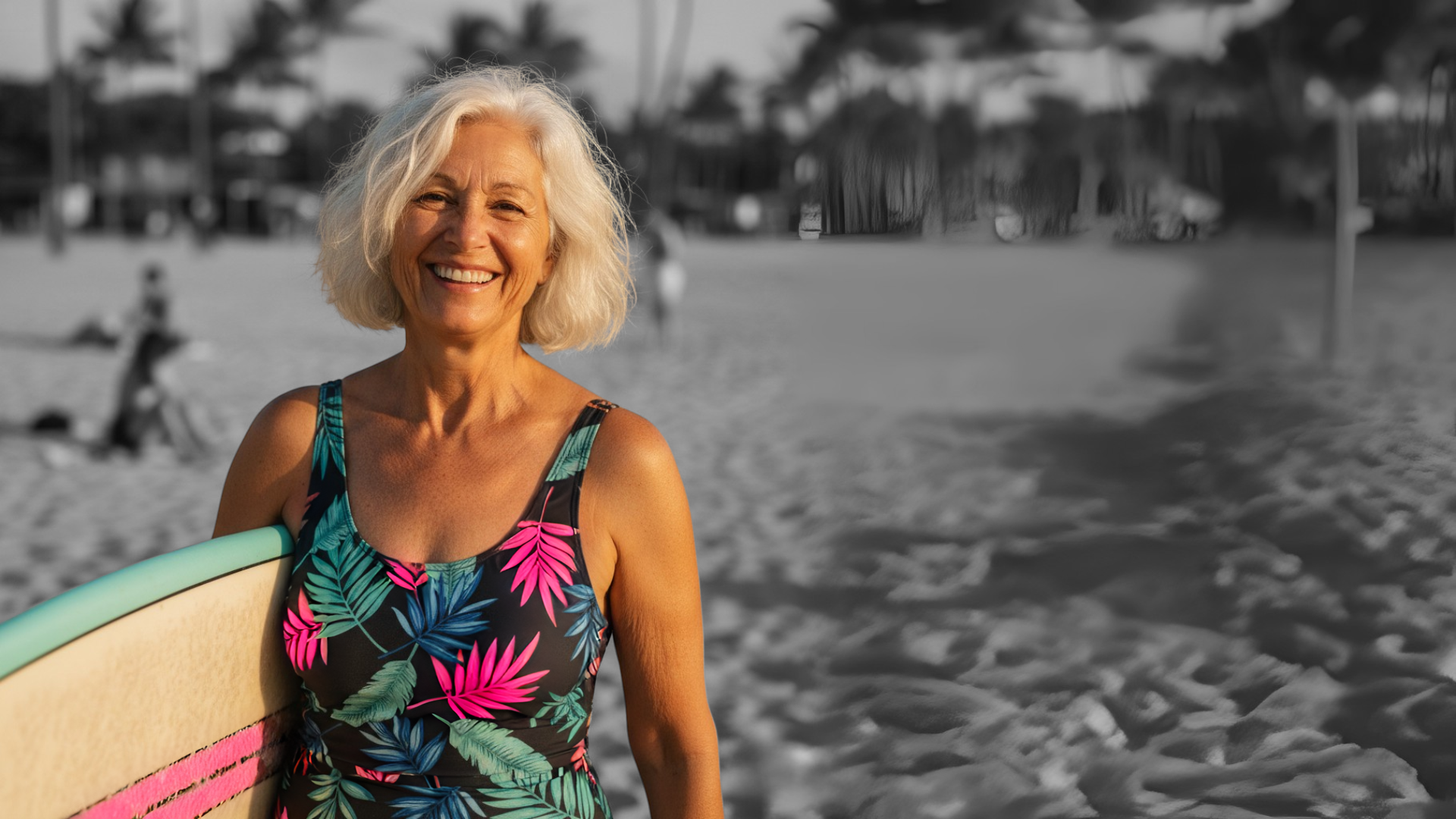
I’ve been feeling frustrated with the overwhelming marketing and endless controversy in the menopause wellness space. So much of it feels inauthentic — more smoke and mirrors than actual support. To make any sense of it, I had to ask myself: what are we all really chasing and why? Which ideals are the menopause gold rush really promoting? Functional health and longevity, or just something good to look at in the mirror? Are we clinging to youth by grabbing every anti-aging product that pops up in our feed? Or are we chasing “sexy,” when let’s be honest… sex is probably the last thing on your mind some days 😉.
And what about the quiet competition — outdoing other women our own age, proving we can look better, thinner, younger? Is this menopause marketplace really about graceful, functional aging? Or is that just bollocks dressed up in marketing glitter?

The menopause marketplace appears to be more glitter than grace.
Enter wabi sabi
Whilst all of these questions were swirling around in my head, an elegant Japanese philosophy3 popped onto my radar: wabi sabi.
Wabi refers to finding beauty in and contentment with imperfections and simplicity1, 2, 3.
Sabi is about appreciating that all natural things deteriorate over time, so nothing is permanent1 and this process of aging can be beautiful3, especially when “the internal essence is seen on the outside.”2
The logic of this philosophy appeals to me: all natural things and states (which includes menopause women😉) are transient or impermanent and therefore they should always be in flux. If all natural things are always changing, they can never be perfect1, 3. Combine this with the truth in sabi – that aging is inevitable – why not do so with grace and acceptance, allowing your inner beauty to shine. This philosophy echoes with my all-time favourite adage: you can’t choose your fate, but you can choose your destiny.
The myth of body fat “ideals”
Let’s take a common challenge of midlife and menopause: weight gain. My original idea was to frame this concept through body fat percentage, because in theory, it’s objective and free from cultural ideals. I wanted to ask: over the past 20 years, have the “experts” shifted their recommendations for what a desirable body fat percentage is in midlife women? If they had, it would be a perfect example of impermanence.
But here’s the twist: No major health or exercise authority — not WHO, NIH, ACSM EASO (to name but a few, see the footnote) has ever declared an ‘ideal’ body fat percentage for women over 50.
The silence is telling.
And yet, we live in a world full of “experts” and influencers prescribing specific body fat percentages — numbers often framed as the key to looking slimmer, fitter or sexier. But where do these prescriptions come from? Certainly not from medical or scientific authorities.
This highlights the impermanence of the so-called ideal: what women are told to chase isn’t grounded in scientific consensus, but in shifting cultural aesthetics, marketable soundbites, and, frankly, someone else’s opinion of beauty. Still, we feel the pressure to “look” a certain way — to match a number on a scale or a body fat percentage chart. And even if we reach that target, do we find lasting happiness or perfection? I’d venture not.3
The irony is that body fat percentage does matter, but for health, not aesthetics. It is relevant with respect to visceral fat, metabolic syndrome risk, sarcopenia and cardiovascular disease. Which is why wabi sabi feels like such a fitting lens: it reminds us that bodies are meant to change, that impermanence is inevitable.
Signals not symptoms
I found a less provocative signal of menopause to use as an example — one that can’t be measured with a scale, scan or caliper: energy fluctuations. Some days we feel vibrant and unstoppable, other days, sluggish and drained. This is the natural impermanence of energy. And perhaps it’s in those moments of low energy that we receive the most valuable nudge: a reminder to pause, adjust and seek balance through better sleep, movement, nutrition or stress management. These energy fluctuations are not imperfections and accepting that they happen is not compromising. In a wabi sabi framework, acceptance is freeing and creates the space for growth3.
And then there’s the very important sabi side of things: the beauty that comes with time. We live in a world that spends billions trying to erase the signs of aging — creams, serums, injections, fillers — all because getting older is seen as a flaw, an imperfection. Ironic, because life is imperfect, just not in the way the beauty and fitness industry wants us to believe.
Every so-called ‘imperfection’ tells a story.
Laugh lines remind you of joy. Grey hairs depict wisdom. Scars speak to resilience and fortitude. Achy joints testify to a body that has carried you through years of living.
Worth pondering, isn’t it?
Living midlife the wabi sabi way
But you are probably also wondering how wabi sabi can parlay into managing our midlife changes and insuring our healthy longevity.
Itani (2021) suggests that we “accept what is, stay in the present moment and appreciate the simple, transient stages of life.”
By accepting our age-related changes, we give ourselves space to learn and grow. That learning and growth happens in the present: right now is when we can excel at taking responsibility for our health, so that we can move with grace and function into the next stage of our lives.
Aching joints may be the signal that you need to move differently now – not when you feel better at some time in the future. By strengthening muscles and improving mobility, you create the opportunity for your joints to carry you well into your next stages.
Weight gain may be the signal of hormonal and metabolic shifts. It’s not a cue to punish yourself with extreme diets or excessive exercise, but rather to create the space to adjust your nutrition, build lean muscle and restore metabolic balance, ensuring energy, strength and function for what comes next.
Disrupted sleep may be your nervous system asking for attention. Accepting it now opens the space to change routines and environments that afford you a restored and healthier body for the day and days ahead.
This philosophy of wabi sabi resonates with me, because it underscores the fact that midlife is a normal, natural phase of life, in which normal and natural things happen to us. It also aligns with my values of striving for quality in life over aesthetics. Both can be lost in a moment, yet only one carries true worth.
Excellence in the habit of change is far more powerful than chasing perfection.
If we accept that midlife and menopause happen and stop trying to outfox it, we can live these changes with gratitude and authenticity. Of course, embracing and practicing it is not going to be an overnight success. As with any habitual change, small consistent steps matter and, since perspective itself is impermanent, excelling at the habit of change is far more powerful than chasing perfection.
It will require that you evaluate what is truly important to you and you may be surprised by how small and simple these things are. It may also require that you acknowledge your flaws – physical, emotional, behavioural, which may leave you feeling vulnerable. I believe vulnerability is strength; the strength to ask for help from ourselves and others. And in that moment of honest acceptance, you may just discover that midlife — imperfect, transient and raw — is already wabi sabi in motion.
FOOTNOTE:
Not one of the authorities below prescribes an ideal body fat percentage for women over 50: the World Health Organization (WHO) and the U.S. National Institutes of Health (NIH) define risk through BMI and waist circumference measurements, not body fat percentage. The North American Menopause Society (NAMS), American Association of Clinical Endocrinologists (AACE), and the European Association for the Study of Obesity (EASO) focus on BMI, waist circumference and weight-loss percentage as health markers. The American College of Sports Medicine (ACSM) and International Society for the Advancement of Kinanthropometry (ISAK) provide measurement methods and normative charts for body composition, but these are descriptive.